Rapid Prototyping and Iteration: How 3D Printing Collapses Design-to-Production Timelines
3D printing is cutting product development timelines from months to days. Here's what that speed shift means for brands developing new products.
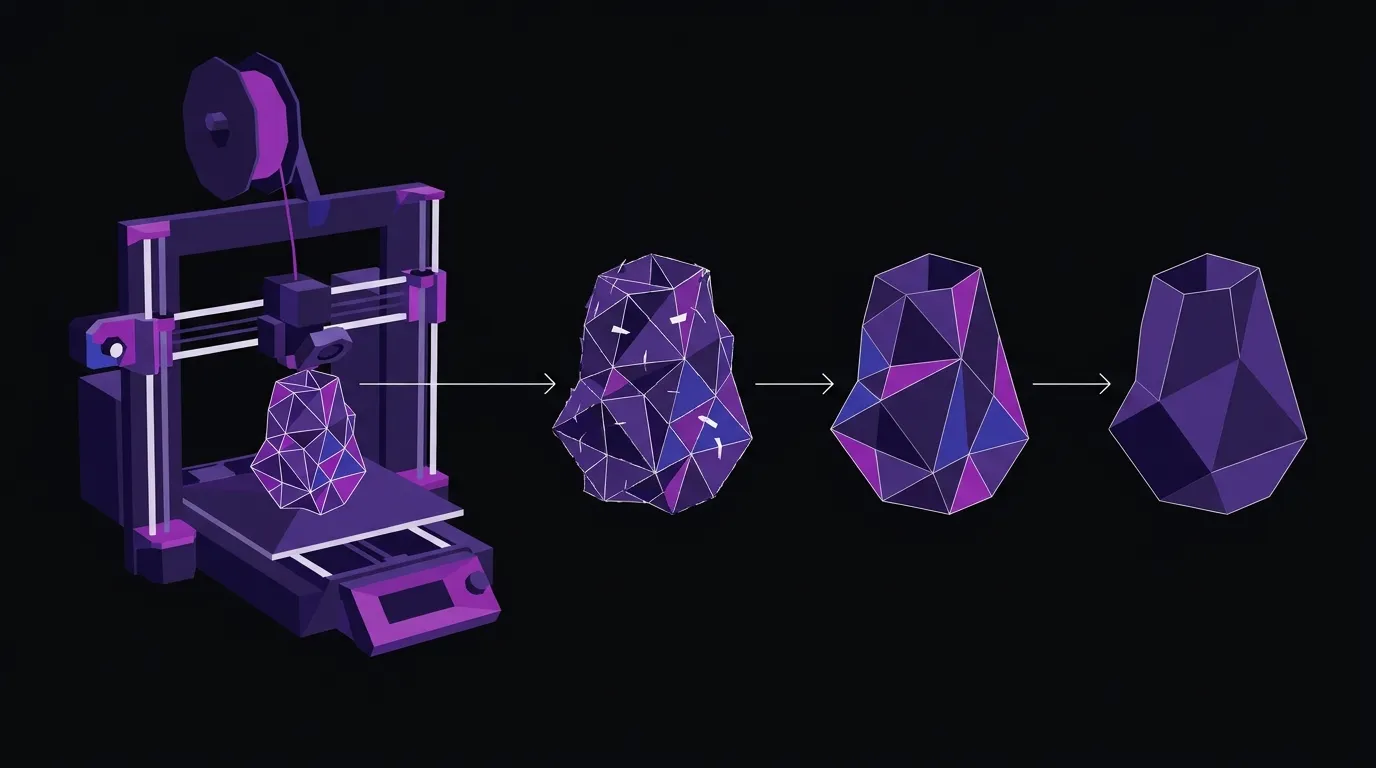
The numbers coming out of real production environments are hard to ignore. Sandia National Laboratories recently reported that its Center for Advanced Manufacturing and Innovation (CAMINO) delivered parts to an internal engineering team in one week — parts that conventional machining would have taken four to six months to produce. That’s not a rounding error. That’s a fundamentally different product development rhythm.
The same pattern is showing up across industries: semiconductor manufacturing, automotive tooling, defense engineering. When you look at these cases together, a clear argument emerges — 3D printing’s primary value isn’t just cost savings or design freedom. It’s the ability to run more experiments in the same calendar window. That changes what’s possible for any business developing physical products.
More Iterations Is the Real Advantage
At Sandia, the CAMINO team has been producing multiple design versions of a power source component that is expensive and difficult to machine through conventional methods. The speed shift didn’t just save time — it changed how the engineering team thinks. As CAMINO manager Mohan Karulkar explained, “the fast turnaround creates an opportunity to actually experiment with designs and try out new ideas.”
That’s the point most businesses miss when they evaluate 3D printing. They calculate the cost of a print run and compare it to a machined part. The better question is: how many design variations can you afford to test before committing to tooling? With a six-month lead time per iteration, you might test two or three. With a one-week turnaround, you might test twenty.
Sandia’s power sources team went further. They developed a thermoplastic polyurethane (TPU) surrogate — a printed stand-in for an insulation material that is costly and slow to obtain — and were able to produce new surrogate iterations in 12 hours instead of 12 weeks. The surrogate isn’t the final part. It’s a tool for learning faster. That’s the mindset shift.
Speed Pays Off Even When the Part Is Complex
The semiconductor case makes a different argument: that 3D printing can compress timelines even for highly specialized, tight-tolerance components — not just simple prototypes.
Singapore-based additive manufacturing specialist Creatz3D delivered 600 sets of 3D printed alumina lift pins to a global semiconductor foundry — components that operate inside chemical vapor deposition chambers under high temperature, plasma, and vacuum conditions. The full production cycle, covering printing, debinding, sintering, and post-processing, took six weeks. The foundry’s previous supply chain ran in months.
Alumina (Al₂O₃) was selected for its mechanical strength, wear resistance, and electrical insulation properties. These aren’t hobby-grade parts. They’re precision components that had to pass a full production qualification process. And they still came in faster than the conventional supply chain.
The business consequence for the foundry was supply chain resilience — local production meant less dependence on overseas sourcing and uninterrupted qualified production. That’s a different kind of speed advantage: not just faster development, but faster recovery when supply chains break.
The Tooling Trap — and How Scanning Closes the Loop
One place where speed gains get quietly eaten up is mold trials. Automotive lighting manufacturer Danyang Sanyou Optoelectronic Equipment Co., Ltd. produces concentrators and lenses for vehicle lamps — parts with irregular curved geometries that are nearly impossible to check with calipers or coordinate measuring machines. Their mold trial cycle used to run two to three weeks per iteration.
By pairing their process with a high-precision 3D scanner — the SHINING 3D OptimScan Q9 — they cut that cycle to under one week. Each trial part is now scanned in minutes, compared against design data, and reviewed via a color-coded deviation map that shows exactly where the mold is off. That data drives the next process adjustment. Fewer iterations needed, faster sign-off.
The lesson here isn’t just about scanners. Sandia’s 12-hour surrogate cycle only delivers its full value if the inspection step doesn’t reintroduce the weeks it saved. The full speed advantage only materializes when measurement and verification keep pace with fabrication. A faster print means nothing if sign-off still takes two weeks.
This is where pipeline thinking matters. Speed at any single step is only as valuable as the speed of the steps around it.
What This Means If You’re Developing a Physical Product
These examples come from semiconductor fabs, national labs, and automotive suppliers — but the underlying logic applies at any scale. If your business is developing a new product, a custom component, a branded physical object, or a limited-edition offering, the traditional path (design → vendor quote → tooling → samples → revision → production) is slow by design. Each handoff adds weeks.
3D printing doesn’t eliminate that path. But it can front-load the learning. Print a functional surrogate. Test it. Break it. Revise the file overnight. Print again. By the time you’re ready to commit to tooling or a production run, you’ve already found the problems that would have cost you two revision cycles and four months. If your current iteration cycle is longer than three weeks, the math on a print-first workflow almost always favors adding fabrication before committing to tooling.
Faster iteration doesn’t just save time on one product — it builds the institutional knowledge that makes every subsequent product cheaper to develop.
For product businesses thinking about what desktop fabrication makes possible — from custom branded objects to production fixtures and small-batch components — our 3D printing and prototyping services are built around exactly this kind of iterative workflow.
The Brands That Win Are the Ones Who Learn Fastest
Here’s the position we’d take: the primary reason to add 3D printing to a product development process isn’t to save money on individual parts. It’s to compress the window between “idea” and “tested, validated design.” That window is where competitors catch up, where market timing slips, and where costs quietly accumulate in the form of delayed revenue.
The Sandia, Creatz3D, and Danyang Sanyou cases all point to the same truth from different angles. Sandia found that faster parts enabled design experiments that were previously impossible — some of the new ideas were only achievable using additive manufacturing. Creatz3D showed that even complex, qualified production parts can move from design to delivery in weeks. Danyang Sanyou showed that closing the measurement loop is just as important as closing the fabrication loop.
Put those together and you get a clear picture: the brands and manufacturers that win on timeline aren’t necessarily the ones with the biggest budgets. They’re the ones who’ve built a workflow where learning is fast, feedback is immediate, and commitment to expensive tooling comes only after the design is already proven. Every month spent in a slow iteration loop is a month a faster competitor is already testing their third revision.
Ready to shorten your product development cycle?
We run FDM fabrication for prototyping, fixtures, and small-batch custom parts. Tell us what you're building.