
Why AI Search Makes Great Web Design and Brand Identity More Critical Than Ever
AI search is changing how small businesses get found online — and it’s raising the bar for what a well-designed digital presence actually needs to do.
There’s a lot of noise right now about what AI search means for small businesses. Most of it focuses on tactics: post more content, optimize for citations, update your Google Business Profile. All of that matters. But there’s a more fundamental point being missed in most of these conversations.
AI search systems don’t just crawl your website for keywords. They evaluate the quality, credibility, and consistency of your entire digital presence before deciding whether you’re worth surfacing in a result. And the businesses that are winning in AI search — the ones getting cited, the ones showing up in AI Overviews — almost universally have one thing in common: they look and perform like professional operations across every digital touchpoint.
That’s a web design and brand identity problem as much as it’s an SEO problem. Google itself has now confirmed as much: their recently released official guide to optimizing for generative AI features states that the same fundamentals that have always driven Google Search performance — technical quality, content credibility, page experience — are the foundation for visibility in AI search experiences too. There is no separate AI optimization strategy. There is only doing the fundamentals well. And the fundamentals are, at their core, a design problem.

What AI Search Changes Mean for Small Business Web Design
Google’s integration of AI into its core search experience has changed what a search result looks like. AI Overviews — synthesized answers generated by Google’s Gemini AI and served at the top of the page — now appear in approximately 20% of all Google searches according to SeoProfy. Google’s newer AI Mode takes it further: a fully conversational search experience with no traditional results at all, just an AI-generated response with citations.
The click impact is significant. Tank’s 2026 AI Search Shift Report found that nearly 60% of searches now end without a click — the AI answer is sufficient and the user never reaches any website. And seo.com’s analysis found that AI Overviews lower average click-through rates by 34.5% on queries where they appear. For small businesses, eSEOspace reports that sites that haven’t adapted are seeing 20 to 40% traffic declines on informational queries.
~20%
of Google searches now show AI Overviews
(SeoProfy, 2026)
60%
of searches end without a click
(Tank, 2026)
34.5%
average CTR drop when AI Overviews appear
(seo.com)
Here’s the part most articles stop at: they tell you traffic is dropping and give you a list of content tactics. What they don’t address is why some businesses are getting cited inside those AI answers while others are invisible — and what role design and brand quality play in that outcome.
What AI Search Is Actually Evaluating About Your Small Business Web Design
When Google’s AI assembles an answer, it’s pulling from sources it considers authoritative and trustworthy. Launchcodex’s analysis of Google I/O 2026 confirms that brands cited inside AI Overviews earn 35% more organic clicks than non-cited competitors on the same queries — making citation the new position one. But what makes a source citation-worthy to an AI system?
The answer goes well beyond keywords and backlinks. AI systems evaluate what’s sometimes called entity authority — how credible, consistent, and well-corroborated a business appears across its entire digital footprint. And entity authority is shaped heavily by things that live squarely in the domain of design:
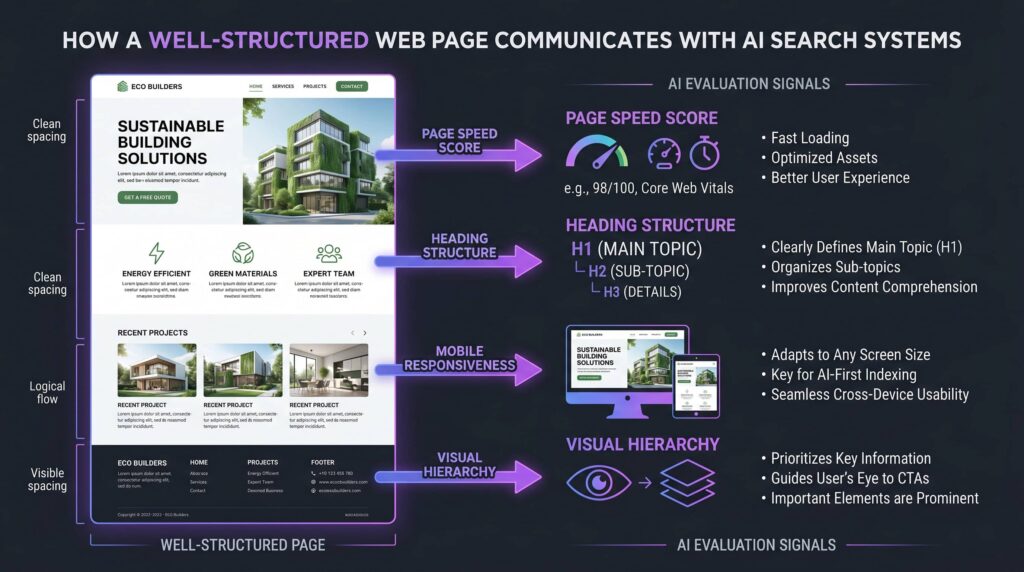
- Does your website load quickly and perform well on mobile? Page speed and Core Web Vitals are direct signals. A slow, mobile-broken site is a low-quality signal regardless of its content.
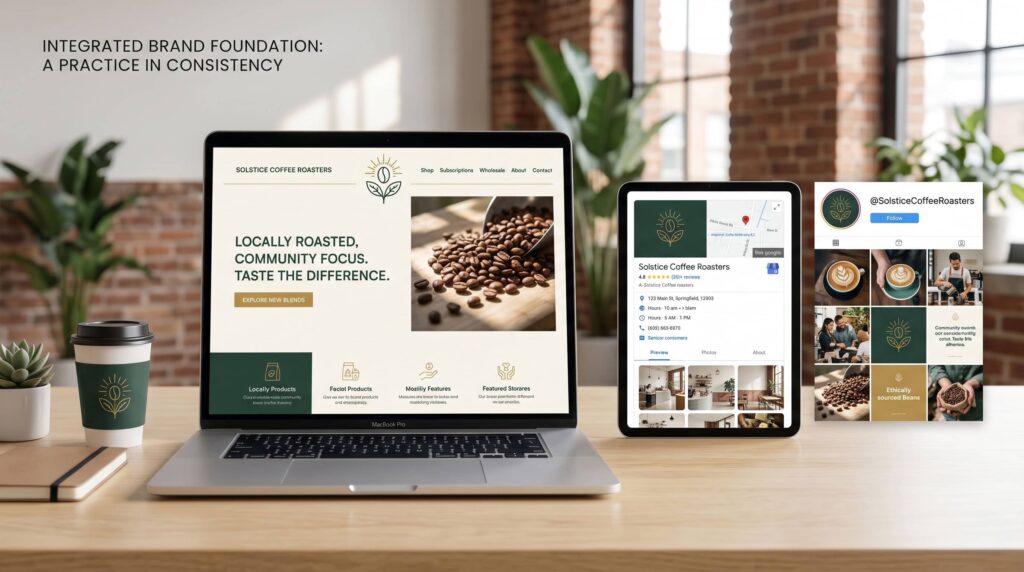
- Is your visual identity consistent across platforms? AI systems read the coherence of a brand’s presence across its website, social profiles, and Google Business Profile. Inconsistency signals a disorganized operation.
- Does your website structure help AI parse your content? Clear heading hierarchy, semantic HTML, and a logical information architecture directly affect how AI systems read and categorize your content.
- Does your design communicate credibility at first glance? Trust is established visually in seconds. A dated or visually incoherent design reduces the perceived authority of every word on the page.
- Does your content demonstrate real expertise and experience? Google’s AI guide places significant weight on E-E-A-T — Experience, Expertise, Authoritativeness, and Trustworthiness. Every one of those factors has a design expression: professional visual presentation, visible author credentials, portfolio proof, case studies, trust signals on page. Design is how E-E-A-T becomes visible.
- Is your content non-commodity? Google’s guide draws a clear line between generic, templated content and content that offers unique, expert-led insight. A website built from a generic template with AI-generated copy fails this test. A site built with intentional design, original content, and a distinct point of view passes it.
“AI search is doing what a discerning human customer does — making a rapid judgment about whether this business looks credible enough to be worth citing. Design is how that judgment gets made.”
How Your Web Design Quality Directly Affects AI Search Visibility
Web Design Performance and AI Search: Speed Is a Citation Signal
Google has been using page speed as a ranking factor for years — and their official AI optimization guide explicitly confirms that Core Web Vitals, load times, mobile usability, and overall page experience remain important signals for AI features in Search. Their exact framing: “The same things that help users help Google’s AI.” That’s as direct a statement as Google makes.
Performance-first web design — building lean, fast sites that score green on Core Web Vitals from the ground up — isn’t just a user experience improvement. It’s an AI search signal. A well-built website is a technically credible website, and technical credibility feeds directly into citation eligibility.
Web Design Performance Signals That Feed AI Search Authority
- Core Web Vitals scores in the green across mobile and desktop — confirmed by Google’s AI guide as an important AI search signal
- Optimized images served in next-gen formats (WebP, AVIF)
- Semantic HTML structure with clear heading hierarchy (H1 → H2 → H3)
- Structured data markup (Schema.org) — helpful for making content more parseable by AI systems, though Google notes it is not strictly required for AI features
- Mobile-first responsive design with no broken layouts at any viewport
- Minimal render-blocking resources and clean, lightweight code
Web Design Clarity and AI Search Content Readability
Google’s AI guide describes “agent-friendly sites” — sites that AI systems can navigate, parse, and draw from effectively — as those with “strong fundamentals: clear structure, accessible content, and good usability.” Read that again: clear structure, accessible content, good usability. That is a web design brief, written by Google. A site with confusing navigation, buried service information, walls of undifferentiated text, and no clear visual hierarchy fails this standard. Google’s guide makes it explicit: pages that commit to one idea per section and name their subject clearly are significantly more citation-eligible than pages that hedge across multiple topics in the same block of text.
Clear web design is citation-friendly web design. Pages with strong visual hierarchy, defined sections, explicit headings that describe content, and a logical information architecture are significantly easier for AI to parse, categorize, and draw from when assembling an answer. Good design and good AI search performance are the same thing expressed differently.
High-Quality Images and Video as AI Search Citation Opportunities
This is the point most AI search articles overlook entirely: Google’s AI guide explicitly states that AI features can surface relevant images and video alongside web page citations — and that following image and video SEO best practices “is already optimizing for generative AI search.” That’s a direct expansion of citation surface area that is entirely dependent on visual design quality.
A website with professionally produced, properly optimized imagery doesn’t just look better to human visitors — it creates additional citation opportunities in AI search results beyond the web page link itself. A site with stock photography, unoptimized files, and no image alt text leaves those opportunities on the table. This is one of the most tangible, underappreciated ways that design quality directly translates into AI search visibility.
How Brand Consistency Across Platforms Builds AI Search Entity Authority
AI search systems don’t evaluate your website in isolation. They assess how consistently and coherently your business appears across the entire web — your website, your Google Business Profile, your social media profiles, your directory listings, and anywhere else your business name and identity appear. This is entity authority, and brand design consistency is one of its most direct inputs.
A business whose logo looks different on its website than on its Facebook page, whose color palette shifts between Instagram and its Google profile, and whose visual identity has no coherent through-line across touchpoints is a weaker entity signal than one that presents a unified, recognizable brand everywhere it appears. To an AI system trying to determine whether a business is an authoritative source, visual and brand coherence is a proxy for organizational credibility.
Brand Identity Consistency as an AI Search Signal
When your brand identity is built properly — with a defined logo system, a consistent color palette, a clear typographic system, and a documented voice and tone — applying it consistently across every platform becomes straightforward. Your website, your GBP cover photo, your Instagram profile, your email signature, and your business card all immediately communicate the same brand. That coherence is read by AI systems as the signature of a well-run, established operation.
When brand identity is absent or inconsistent, the opposite happens. Each platform looks slightly different. The business projects a fragmented, improvised presence. AI systems weigh that fragmentation as a lower-quality signal — even if the underlying business is excellent.
Brand Identity Consistency Signals for AI Search Entity Authority
- Consistent logo usage across website, GBP, social profiles, and directory listings
- Unified color palette applied the same way across every digital touchpoint
- Typography and visual style that reads as the same brand wherever it appears
- Brand voice and tone consistent across website copy, social captions, and review responses
- Photography and imagery direction that feels cohesive across all platforms
- A documented brand guidelines system that ensures consistency as the business grows

The Web Design and Brand Identity Foundation AI Search Rewards
Here’s the conclusion that most AI search articles miss: you cannot content-market your way to AI search visibility if the foundation beneath the content is weak. A business that publishes content consistently but serves it from a slow, visually dated, mobile-broken website is producing citation-ineligible content. A business posting actively on social with a logo that looks different from its website is building a fragmented entity signal that undercuts every post.
Google’s own AI optimization guide puts it plainly: there is no separate AI search strategy. The foundation for visibility in AI features is the same as it has always been — technical quality, credible content, and a trustworthy, well-maintained presence. What Google’s guide adds that most small businesses haven’t internalized yet: visitors arriving via AI Overviews tend to be more engaged than those from standard organic results. These are not casual browsers — they’re people who received a curated answer and then specifically chose to follow the citation. When someone arrives at your site through an AI search citation, they’re already primed. The quality of what they land on determines whether they convert.
The businesses that will win in AI search over the next two to three years are the ones building from the right foundation now: a professionally designed, fast, mobile-optimized website; a cohesive brand identity applied consistently across every platform; original, expert-led content that AI systems recognize as non-commodity; and high-quality imagery that expands citation surface area. All of that is design work before it’s anything else.
This is not a new argument dressed up in AI language. It’s the same thing good design has always done: communicate credibility, build trust, and make a business look like it belongs at the top. AI search has just made the stakes of getting it wrong considerably higher. As we’ve covered in our breakdown of what makes a small business website actually work, your digital presence is performing — or failing to perform — around the clock. In an AI-first search environment, the quality of that performance determines whether you exist in the search results your customers are seeing.
“Google confirmed it themselves: the same fundamentals that have always driven search performance drive AI search performance too. And the fundamentals are, at their core, a design problem.”




Build the Foundation AI Search Actually Reward