
Why Small Businesses Can’t Afford to Ignore Their Brand Identity
The Hidden Cost of Ignoring Your Brand
Here’s what happens when a small business skips branding: potential customers can’t tell what you do or why you’re different. Your marketing messages hit the right people but produce the wrong results — more questions than sales. And those same potential customers end up buying from a competitor who, despite a comparable offering, looks like they have it together.
“The brand that looks polished wins the consideration. Every time.”
The confusion that poor branding creates, the trust it fails to build, the customers it sends elsewhere — all of that has a real dollar value attached, even when it never shows up on a P&L. And here’s the stat that should stop any skeptic cold: your brand can account for 30 to 50 percent of your business’s total value. Not revenue — value. The equity you build every time someone interacts with your brand either compounds or erodes depending on how intentionally you’ve designed it.
You could have the best product in Los Angeles and still lose to a competitor with a better-looking brand. That sounds harsh — but it’s the reality of a market where customers form opinions in seconds, trust is won or lost at first glance, and the businesses that look the part tend to get the part.
Brand identity isn’t decoration. It’s strategy. And the businesses that truly get ahead don’t just build a brand — they document it, systematize it, and protect it. Yet for many small business owners, branding gets pushed to the back burner. There’s product to move, services to deliver, invoices to send. Who has time to worry about fonts and color palettes? The answer: anyone who wants to grow.
First, Let's Clear Up the Confusion
The words brand, branding, and brand identity get used interchangeably all the time — but they mean different things, and the distinction matters.
- Your brand is how people feel about your business. It’s the impression that lives in their heads.
- Branding is the active process of shaping that impression through design, messaging, and experience.
- Brand identity is the toolkit that makes it happen — the logo, color palette, typography, tone of voice, imagery, and every visual and verbal touchpoint your audience encounters.
Think of your brand as your reputation, and your brand identity as the wardrobe you wear to build it. One is perception; the other is the tangible system that drives it. And brand guidelines — which we’ll get to — are the rulebook that keeps that system running consistently over time.
Why Branding Matters More for Small Businesses
There’s a persistent myth that brand identity is a big-company luxury — something you invest in after you’ve made it. The truth is exactly the opposite.
Large corporations can outspend competitors on advertising, buying visibility whether or not their brand is coherent. Small businesses don’t have that option. Your brand identity is your media budget. It’s the reason someone pauses on your post instead of scrolling past. It’s why a referral follows through. It’s what turns a first-time customer into a regular.
The numbers back this up:
- Consistent branding can boost revenue by up to 23% across platforms
- 78% of small business owners say visual branding plays a significant role in revenue growth
- Your brand can account for 30–50% of your total business value
Small businesses also have something the enterprise world can’t easily replicate: authenticity and story. A strong brand identity gives that story a visual and verbal form that people can connect with, remember, and pass on.
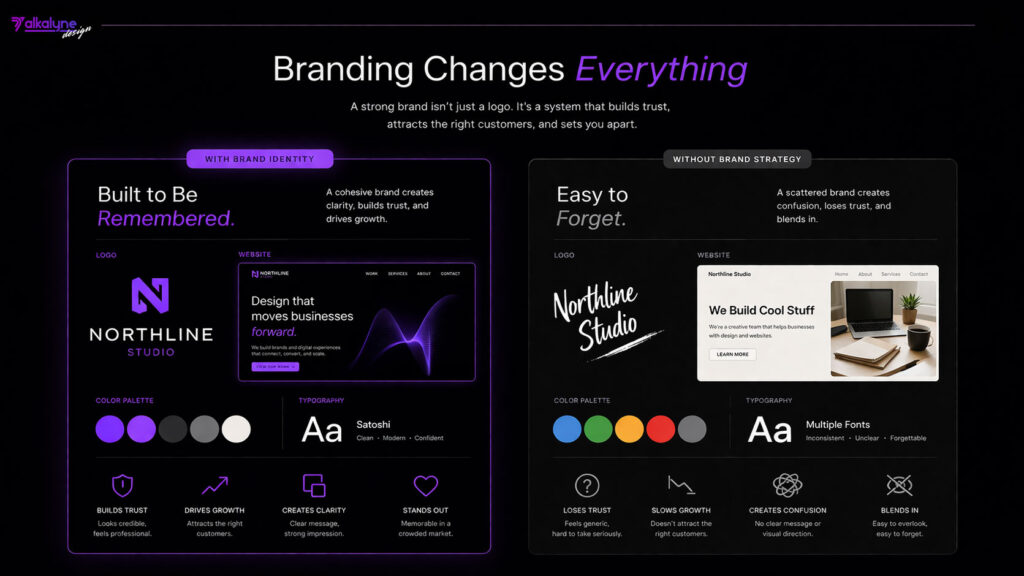
The 5 Pillars of a Strong Small Business Brand Identity
Brand identity isn’t a single thing you design once and forget. It’s a system of interconnected elements that work together. Get all five right and the result is a brand that feels unmistakable — and impossible to forget.
01 — Visual Identity
Your logo, color palette, typography, and imagery form the foundation of everything customers see. These aren’t arbitrary aesthetic choices — they’re psychological signals. Colors evoke emotion, fonts suggest personality, imagery sets expectation. A strong visual identity looks great everywhere: website, business card, packaging, signage, social avatar.
02 — Voice & Tone
How you speak to customers is as much a part of your brand as how you look. Are you warm and conversational? Authoritative and direct? Playful and irreverent? Your tone should stay consistent across homepage copy, email follow-ups, and Instagram captions alike. Inconsistency in tone creates cognitive dissonance — it signals that no one’s really minding the brand.
03 — Brand Story & Values
People don’t just buy products and services — they buy into who you are. Why does your business exist? What drives every decision you make? A clearly articulated brand story humanizes your business and creates emotional connection. That connection is what turns first-time buyers into loyal advocates who refer friends without being asked.
04 — Consistency Across Every Touchpoint
Consistency is the multiplier. Every time a customer encounters your brand — on your website, your packaging, your Google Business profile, even your invoice template — and it looks and feels the same, that recognition compounds. Every inconsistency chips away at trust. But consistency doesn’t happen by accident. It requires a system — which is exactly what brand guidelines exist to create.
05 — Online Presence
Your website and social profiles are often the first place a potential customer encounters your brand. They need to be a perfect expression of your identity. A slow, outdated, or visually inconsistent website undercuts even the most beautifully designed logo. Your website is your brand’s most powerful sales tool — treat it like one.
The System Behind the Brand: Your Brand Guidelines
Building a great brand identity is one thing. Keeping it consistent as your business grows, brings on team members, works with vendors, or updates its marketing — that’s another challenge entirely. This is where most small businesses fall apart.
Brand guidelines — sometimes called a brand style guide or brand standards document — are the rulebook that governs how your brand looks, sounds, and shows up in the world. Think of them as the owner’s manual for your brand identity. Without them, every new hire, every designer you work with, and every platform you expand into becomes a potential point of inconsistency.
What Brand Guidelines Include
A complete brand guidelines document covers every element of your brand identity and specifies exactly how each one should be used:
- Logo usage rules — approved variations, minimum sizes, clear space requirements, and what never to do with the logo
- Color palette — primary and secondary colors with exact hex, RGB, CMYK, and Pantone values for consistent reproduction across digital and print
- Typography system — primary and secondary typefaces, hierarchy rules, sizing, and pairing guidelines
- Tone of voice — the personality of your brand in words, with examples of on-brand vs. off-brand language
- Imagery direction — the style of photography, illustration, and graphics that align with the brand’s aesthetic
- Application examples — mockups showing how the brand appears on business cards, social media, signage, packaging, and more
Why They Matter
Brand guidelines do three things that no amount of good intentions can replicate. First, they protect your investment. Every dollar you put into your brand identity is only valuable if it’s applied consistently. Guidelines ensure that the logo on your website, the colors on your packaging, and the tone in your emails all point to the same brand.
Second, they scale with your business. When you bring on a new team member, hire a freelancer, or work with a print vendor, brand guidelines give everyone the information they need to represent your brand correctly — without you having to supervise every asset.
Third, they signal professionalism. A business that can hand a vendor a polished brand guidelines document is a business that takes itself seriously. That confidence is contagious — it shows up in how partners, clients, and investors perceive you.
See a Real Brand Guidelines Document in Action
What a Strong Brand Actually Buys You
Beyond the intangibles, a well-developed brand identity delivers measurable business outcomes.
Trust and credibility. Customers are significantly more likely to purchase from businesses that look professional and polished. Even a one-person operation with a coherent brand can project the credibility of an established company. In a market where 61% of customers already feel treated like a number rather than an individual, a brand that feels human and considered is a genuine competitive advantage.
The right customers, more often. When your brand clearly communicates who you are and who you’re for, you stop attracting the wrong leads. Your visual identity and messaging pre-qualify your audience — more aligned clients, less friction, fewer “is this a good fit?” conversations.
Marketing that works harder. A clear brand identity makes every marketing effort more efficient. Your social posts, email campaigns, paid ads, and printed collateral all share a unified visual and verbal language. That cohesion shortens the path to purchase and amplifies recall.
Real business value. A strong brand is an asset. It increases your business valuation, strengthens your market position, and — if you ever choose to sell — becomes a tangible line item that buyers pay for.






We Build the Brand. We Document It Too.